
Check Montgomery County's Current Owner Record
The appraisal card is where the assessment roll speaks plainly. One screen joins the landowner and mailing lines to the situs, the parcel number, the legal description, the district, and the deed reference. Land, structures, and value sit on the same card. Read all the fields together. A name result alone proves little without the parcel and deed behind it.
| Owner Name | The landowner name carried on the current assessment card |
|---|---|
| Mailing Address | The destination for owner and tax correspondence |
| Situs | The property's physical address |
| Last Sale Date | A timing lead that must be checked against the recorded instrument |
| Deed Reference | The book and page used to request the conveyance |
| Last Updated | The portal timestamp, not a guaranteed recording-update schedule |
An owner of record is rarely the same thing as an occupant. An out-of-county address, a post-office box, or an In Care Of line is normal. The mailing line is simply a lawful correspondence route. The situs identifies the land.
Verify the Montgomery County Landowner Name
Search the DSM appraisal portal by property address or Land Owner Name. Contains is the default name mode. Starts With narrows a known spelling. The result grid pairs the landowner with the parcel, In Care Of line, property address, city, district, section-township-range, and both true and assessed value. Open the card and copy the parcel string exactly. Montgomery County publishes no parcel-number formula, so a stray hyphen or dropped leading zero can break the handoff to tax and deed records.
Measure How Current Montgomery County Ownership Is
The detail screen carries a Last updated footer. Write it down with the date of the lookup. Then set it beside the card's latest deed-history date. The county states no fixed owner refresh cycle. It also gives no standard lag between recording and a land-roll change. A recent closing, probate order, foreclosure deed, tax sale, or parcel split can open that gap wide. Guessing a typical delay is the wrong move. Treat the card as a timestamped lead, then ask Chancery whether a later deed exists.
Recent-sale check. The roll can lag a conveyance. When dates conflict, the newest recorded deed is the more current ownership evidence.
Confirm the Current Montgomery County Owner
The Chancery Clerk serves as county recorder for land instruments. Montgomery County offers no public online land-record index through LTAMS. Deed verification is therefore an office, terminal, phone, or written-request task rather than a web-only property search.
- Read Owner Name, owner address, situs, parcel, deed date, book, page, and Last updated on the appraisal card.
- Call or visit the Chancery Clerk at 614 Summit Street, Winona, 662-283-2333, during posted weekday hours of 8 a.m. to 5 p.m.
- Ask whether the supplied book/page is the latest conveyance for the same legal description.
- Compare the grantee and vesting language with the tax-roll name, noting any entity, trust, estate, or life estate.
- Owner of record
- The party the official roll presently associates with the parcel.
- Assessment roll
- The county's property list used for classification and taxation.
- Recording lag
- The interval between a deed's filing and a later roll update.
Compare Montgomery County Situs and Mailing Lines
The portal keeps Property Address apart from Owner Address and In Care Of. That separation guards against a common mistake. Owners often receive correspondence elsewhere, so never assume mail goes to the parcel itself. An entity may route it through an agent or manager. Mississippi's Address Confidentiality Program can also help. It gives qualifying survivors a substitute mailing address. A protected or different mailing line is no reason to infer deception or occupancy. Keep the public record in context, and avoid republishing sensitive details.
Verify a Montgomery County Entity Owner
The owner field may name an LLC. Search the exact organization in the Mississippi Secretary of State entity database. A registered agent is the filing contact, not the beneficial owner and not an occupant. Trust details may stay hidden in an entity search. An estate calls for a different step. Turn to Chancery probate records for a decree, an executor deed, or a later transfer. Homestead credit can hint at tax status. It cannot replace the latest deed or establish present occupancy.
Request a Montgomery County Owner Card Offline
The portal sometimes returns no row. In that case, call the Tax Assessor/Collector at 614 Summit Street, Winona, 662-283-2112. Before calling, try the shortest useful street term, an alternate postal community, and section-township-range. Then give the office every form of the address plus any parcel reference. A written request under the Mississippi Public Records Act of 1983, Miss. Code §§ 25-61-1 through 25-61-19, should name the land-roll entry and the desired format. Ask for a cost estimate. The county publishes no printed or certified copy fee schedule.
Do Not Assume Montgomery County Has Deed Alerts
Montgomery County offers no verified property-fraud-alert signup. Senate Bill 2751, introduced in 2026, described a possible statewide deed-fraud notification framework. Proposed text is not proof of a live service. For now, confirm questionable solicitations with the Chancery Clerk and recheck the latest instrument on record. That habit keeps an owner inquiry anchored to services that exist. The introduced bill text documents the proposal's status.
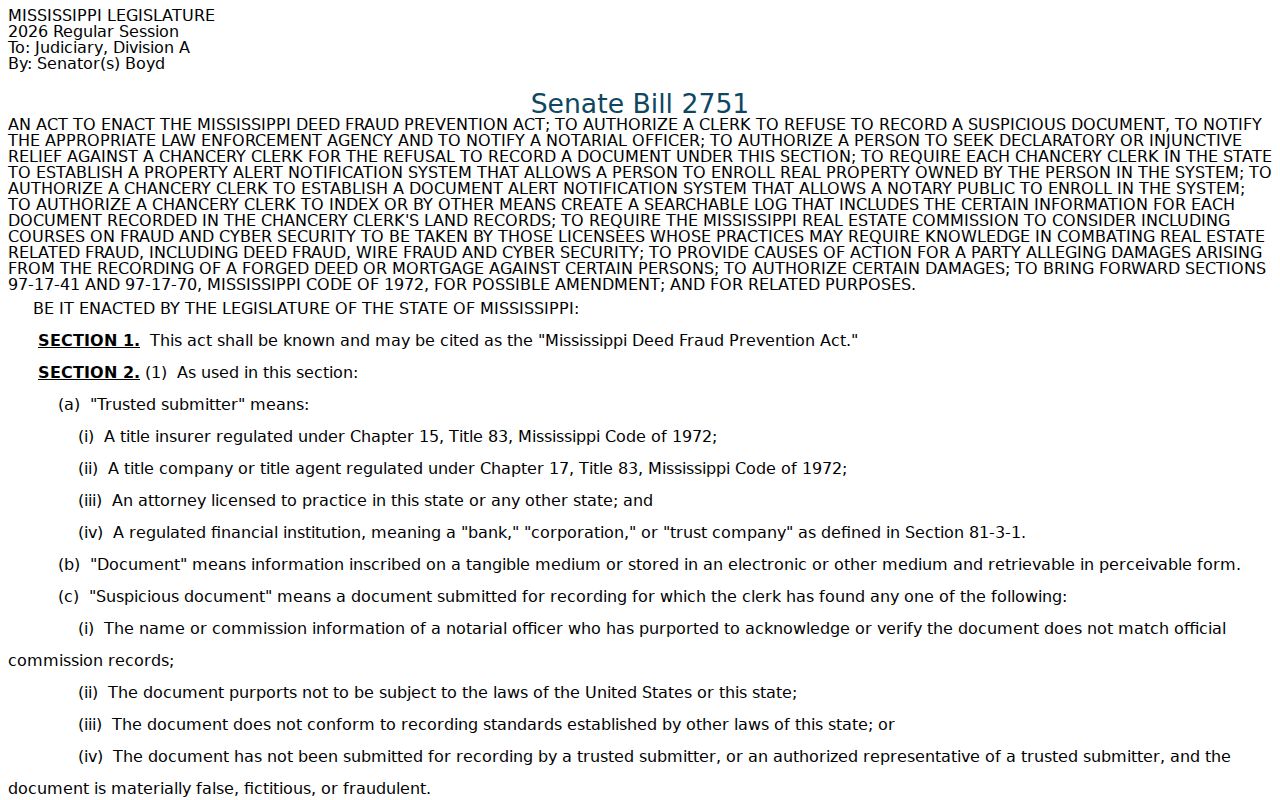
The screenshot supports the caution: it is not an operating county alert enrollment page.
Audit a Montgomery County Owner-of-Record Result
An owner-of-record result earns trust when its parts line up. Pull the landowner name first. Then check the parcel number, situs, mailing address, tax district, and subdivision or rural land keys. Also check the legal description, deed date, book, page, and Last updated value. Appraisal figures such as true and assessed values may appear in the result grid too. Those amounts label the tax record. They do not prove who owns the land. Copy the full row plus the detail card. A bare search-results name leaves out the deed lead and timestamp that confirmation requires.
A same-name match needs more than a match. Compare the parcel and legal description before you accept it. For an entity, keep punctuation and suffixes intact and run both Contains and Starts With. Rural property calls for section, quarter-section, township, range, and community name comparisons. The portal never publishes its exact parcel syntax. Carry the returned string, unchanged, into every tax, GIS, or office query.
A newer update date with an old deed row is a flag. Ask the Assessor whether the card reflects a non-deed change. It may be classification, address, structure, or parcel maintenance. When the deed looks later than the card, ask Chancery whether it is the latest conveyance. Then hand its citation to the Assessor. These checks keep "current" anchored to documented dates in the Montgomery County property records.
Check Montgomery County Ownership After a Special Transfer
A routine sale points to one deed with the buyer as grantee. Probate, foreclosure, and tax-sale events rarely stay that simple. After a death, a will, probate decree, executor deed, or later heir conveyance may appear. Any of these may explain the present vesting in Montgomery County property records. The person handling an estate is not automatically the owner. Trust the final recorded transfer, not a family name or a mailing contact.
Foreclosure work starts with the sale deed. Confirm whether a later conveyance appears before drawing conclusions. For tax-sale property, check the Collector's land-redemption record type. Also check any redemption before treating a sale notice as final. Newspaper and docket notices describe steps in a process. The current deed and final court record show the recorded outcome. The Circuit Clerk may hold property-facing civil judgments. Chancery keeps the core land and probate series, including deed records for the parcel.
Dates matter most in these cases. Keep the event date, recording date, court or book/page citation, parcel, and legal description together. Treat that group as one packet. The packet explains why an assessor name may briefly differ from the newest ownership evidence on the tax roll.
Contact a Montgomery County Property Owner Lawfully
A public mailing line can support a letter about a boundary, a sale inquiry, an estate, or a shared property issue. It does not authorize a visit, repeated contact, or any attempt to uncover a protected residence. A public record is information, not permission.
Lawful use. Use Montgomery County owner information for legitimate property research. Never use it to stalk, harass, threaten, or harm another person.