
Compare the Values on a Montgomery County Property Card
A Montgomery County property value is never just one number. The DSM appraisal card lists appraised and assessed amounts separately for land, for buildings, and for the total. Each figure answers a different question. A deed may state consideration. An actual market sale can reflect conditions the mass-appraisal roll simply does not capture.
| Value | What It Is | Where |
|---|---|---|
| Assessed value | The ratio-based amount used in tax calculations | Assessor card |
| True/appraised value | The assessor's mass-appraisal estimate before the class ratio | Assessor card |
| Last sale price | Consideration for a particular transfer, if shown | Recorded deed |
| Land/building split | Separate appraisal components that make up the total | Assessor detail |
Mississippi applies statutory class ratios, so the assessed value is often only a fraction of true value. Do not compare it directly with a sale price. First identify the class, the date, and the record source behind each figure.
Apply Mississippi Ratios to Montgomery County Value
Mississippi assesses Class I single-family owner-occupied residential real property at 10 percent of true value. Class II other real property and Class III personal property use 15 percent. Class IV public utility property and Class V motor vehicles use 30 percent. The Department of Revenue demonstrates the method with a statewide example. It is not a Montgomery estimate. A $100,000 true value at 10 percent yields a $10,000 assessed value. Applying 125 mills produces $1,250 before credits or adjustments.
Estimate Montgomery County Property Value From the Roll
Start with the official Real Property Appraisal search, and keep the card's year and Last updated date with every number you copy. That timestamp matters. The county publishes no exact coverage or refresh schedule for the portal.
- Search the number, street, and city, or enter the exact returned parcel number.
- Read appraised and assessed land, buildings, and total columns.
- Record land acreage/class and building year, area, condition, and value.
- Check the deed date and book/page with Chancery if a sale-price comparison matters.
- Assessed value
- The ratio-based value used in the tax system.
- True/appraised value
- The mass-appraisal estimate before applying the class ratio.
- Assessment ratio
- The statutory percentage applied for a property class.
- Consideration
- A transfer amount reported in a deed, when shown.
Understand Montgomery County Land and Building Totals
The card splits values into Land, Buildings, and Total, each with appraised and assessed columns. Its building grid can show type, description, year, base area, adjusted area, units, condition, and value. The land grid can show cultivated and uncultivated acres, method, class, unit price, quantity, adjustment, use total, and market value. Together these fields explain how the roll was assembled. They are not an inspection report. Nothing on the card guarantees a structure's current condition.
Separate Montgomery County Sale Price From Assessment
The appraisal card carries deed-history date, book, and page. But it displays no instrument image and no sale-price field. Request the deed from the Chancery Clerk before treating any transfer amount as verified consideration. Some conveyances are simply not market events. A family transfer, estate deed, or partial-interest conveyance can make recorded consideration a poor benchmark. The deed answers one question only. It shows what was recorded for that transfer, not what the property would fetch today.
Keep Montgomery County Millage Apart From Value
The Combined Collection detail can break a tax bill into county, city, school, and separate-school rows, each with millage, gross tax, homestead credit, special credits, forestry, and net tax. Those amounts explain a bill. They do not measure the parcel's intrinsic value. The Combined Collection search shows the categories used to locate the tax record.
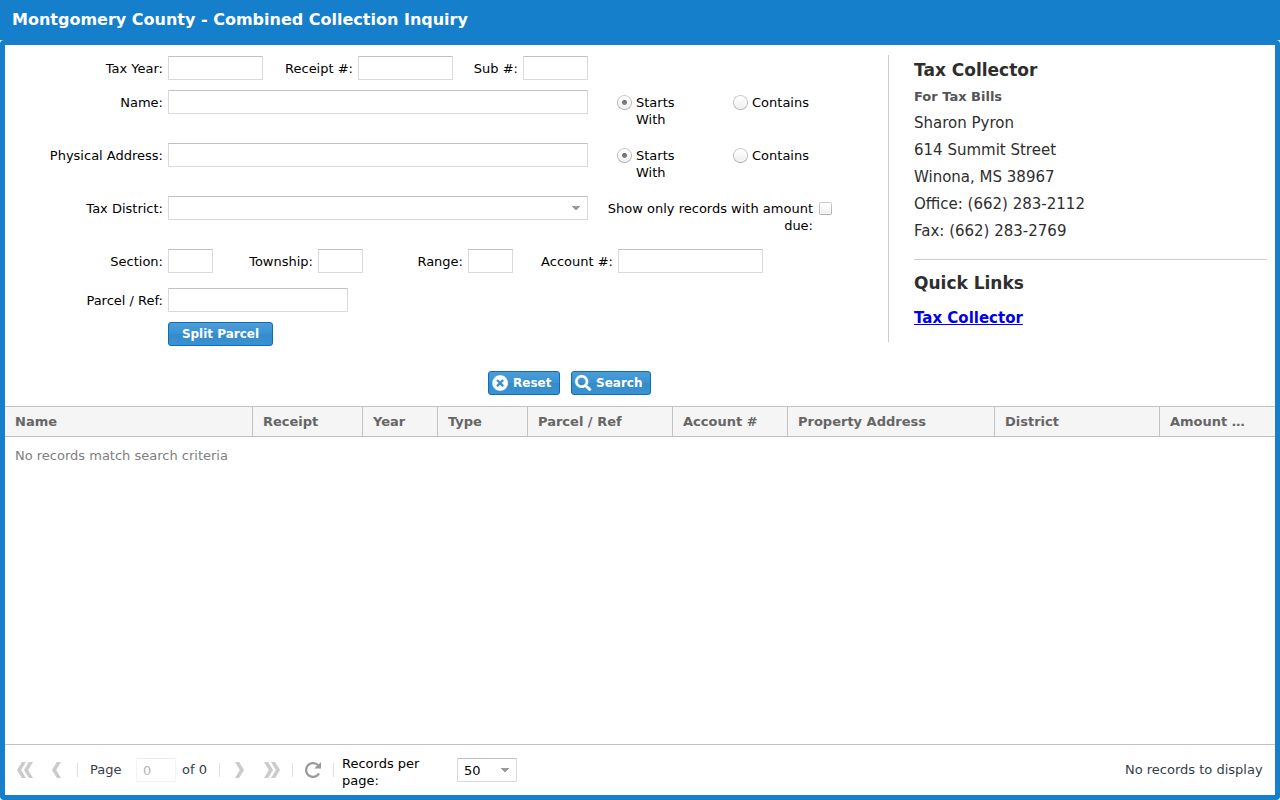
The screen gives useful bill context, but credits and district lines can leave similar properties owing very different totals.
Distinguish Montgomery County Homestead Credit
Homestead applications run from January 2 through April 1 at the Assessor. The credit changes the tax calculation. The class and the assessed value remain separate concepts. Homestead status evidences a tax claim tied to owner occupancy. It is not proof of current title or physical occupancy. Proposed 2026 homestead legislation should not be treated as effective law. Check enactment and effective dates first.
Date Every Montgomery County Assessed Value
The Assessor annually locates, classifies, and assesses taxable property. But the county publishes no exact portal refresh schedule. Save the assessment year, the Last updated footer, and your lookup date. Improvements, class changes, splits, and later reappraisal can all shift the next roll. If the portal fails, request the current card from the Tax Assessor/Collector. The office sits at 614 Summit Street, Winona, 662-283-2112. Verify the mailing box before sending anything on paper.
Compare Historic Montgomery County Assessed Values
MDAH Series 1202 preserves Montgomery tax-roll material, including visible land-assessment examples from 1892 and 1896. The 1892 land series lists 95 items. Historic values came from their own tax system and economic setting. Use them to trace classification and ownership clues. Do not treat them as inflation-adjusted estimates of today's property value.
Audit a Montgomery County Property Value Record
Start with the parcel number and situs. Add the tax district, property class, and appraisal year. Record the Last updated timestamp as well. Then log the appraised and assessed figures for land, buildings, and total, each kept separate. Acreage, land-use rows, and building-card details explain how the total was built, so include them too. Without the date and classification, a copied figure gets mistaken for a current market estimate. It invites bad comparisons as well.
Use the local card's actual fields instead of estimating missing pieces. The building grid may show a card number, type, description, construction year, base and adjusted area, units, condition, and value. The land grid may show cultivated and uncultivated acreage, method, class, unit price, quantity, an adjustment percentage, a use total, and market value. A blank field is not zero. Ask the Assessor about any blank. Save or print the result with its query date. If the portal returns no row, contact the Assessor with the exact address, postal-community variants, section-township-range, and any known parcel. Montgomery's published sources state no historical online coverage or full tax-district list, so an empty result cannot show that the parcel lacks an assessment.
Compare Montgomery County Values Within the Right Class
Two properties of equal true value can carry different assessed values. Mississippi classifications drive the split. Class I covers single-family, owner-occupied residential real property and uses 10 percent, while Class II covers other real property at 15 percent. Personal property, utilities, and motor vehicles carry their own ratios, none of which belongs in a residential parcel comparison.
Land use matters, since a vacant tract, cultivated acreage, an older structure, and a recently improved home reach their totals through different card rows. Compare the appraised land and building components separately. Then apply the correct class ratio. Never infer condition from value alone, because a mass-appraisal card is not a physical inspection.
Tax district and homestead credit sit in another layer. They can shift a bill. The underlying true-value estimate and class ratio stay conceptually distinct, untouched by either adjustment. Focus on what each recorded number means.
Confirm Montgomery County Recorded Consideration
A sale amount starts with the card's deed history. Take the date, book, and page as a request lead for the Chancery Clerk. Ask whether the instrument displays consideration. Ask too whether a later deed affects the tract. The portal shows no Montgomery instrument image. The deed itself must be inspected rather than a price invented from the card.
Then classify the transfer before comparing it with assessed value. Transfers include a family deed, gift, estate distribution, partial-interest deed, correction, life-estate reservation, foreclosure, or tax-sale deed. Such transfers may not reflect an ordinary open-market transaction. Even an arm's-length sale is one date and one agreement. It does not become the assessor's next true value. It is not a current estimate either.
Keep the recording date separate from any execution or closing date shown. A later recording can explain why the land roll still carries the prior owner. It can also explain an earlier value snapshot from the county's records.
Know What Montgomery County Assessed Value Cannot Say
The county figure serves mass appraisal and taxation. It does not predict a negotiated sale. It also cannot replace a site-specific appraisal, establish title, prove boundaries, or account for every private condition shaping a buyer's decision on the parcel.
Value is not price. A Montgomery County assessed value is not what the property will sell for. Obtain a qualified appraisal when a current market opinion is needed.