
Read Montgomery Property Tax Records
Montgomery's public tax search runs through the Combined Collection system. It joins parcel and account keys to the tax year, receipt, district, record type, and current balance. Rates differ by body. County, city, school, and other taxing components may land on one parcel at different levels, so read each line separately to see which charge belongs to which authority.
| Field | What it shows | Where |
|---|---|---|
| Parcel and account | Exact system keys | Tax and appraisal card |
| Year and receipt | Billing period and payment | Collector detail |
| District and type | Tax area and class | Search result |
| Gross tax, interest, fees | Balance components | Current bill |
| Homestead credit | Credit shown for parcel | Assessor record |
Save the query date because payment, correction, interest, or redemption can change the result.
Search Montgomery Tax Bills
A precise parcel or account number is the strongest key. When that key is unknown, an address, owner name, district, receipt, or tax year can narrow the results down to a manageable set.
- Choose real property and the tax year.
- Enter the parcel, account, receipt, address, or name.
- Verify the district, owner, and description.
- Read each tax component, payment, and balance.
- Confirm a delinquent or redemption status with the collector.
Sharon Pyron serves as Tax Assessor/Collector, with the office at 614 Summit Street in Winona and the phone number 662-283-2112. Before mailing any property tax records request, confirm the correct mailing box, since county sources give differing addresses.
Montgomery Tax Search Fields
The collection screen offers many fields. Year, Receipt, Name Starts With or Contains, Physical Address Starts With or Contains, District, Account, Parcel, and Record Type all appear, and a broad surname or road search can return many parcels at once. The account and parcel fields pin down one record.
| Key | Best use | Caution |
|---|---|---|
| Name | Possible holdings | Try initials and entities |
| Physical address | Known site | Postal place may differ |
| District | Tax area | Not unique alone |
| Account or parcel | Exact match | Keep zeros and separators |
The live Montgomery County Combined Collection search displays those filters in one public form.
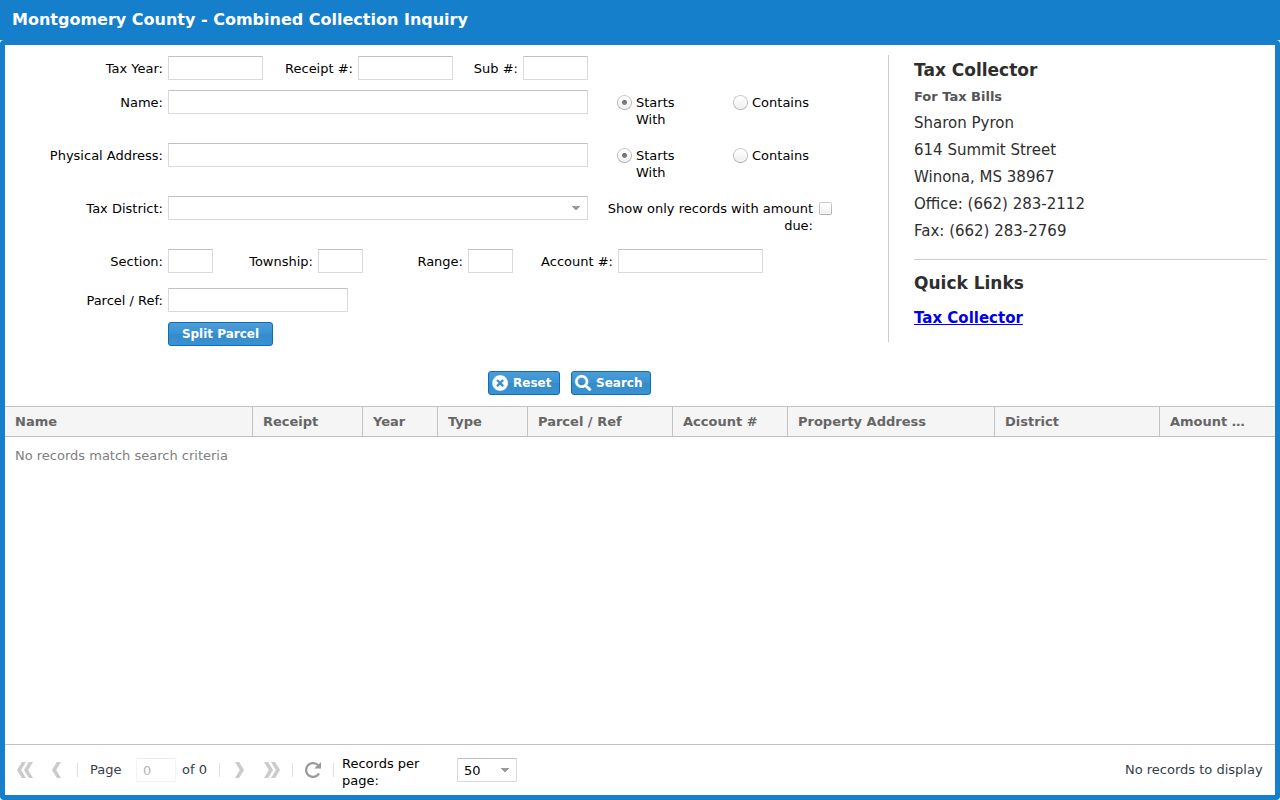
The screen lists search choices only. It shows no taxpayer balance, and no complete coverage-year range is published, so ask the office about older or missing years.
Value Math in Montgomery Records
Mississippi applies a class ratio first. Class I owner-occupied single-family real property is assessed at 10 percent of true value. Class II covers other real property at 15 percent. Class IV public utility property sits at 30 percent, and the assessed value is then combined with millage and lawful credits.
- True value
- The assessor's full-value estimate for tax work.
- Assessed value
- True value after the class ratio.
- Mill
- One dollar per thousand dollars of assessed value.
- Homestead exemption
- A qualifying owner-occupant tax benefit.
- Tax lien
- A claim tied to unpaid property tax.
A state example explains the formula but is not a Montgomery parcel estimate.
Apply for Montgomery Homestead
Homestead applications run from January 2 through April 1 at the Assessor's office. The window is short. Ask the office which form and evidence apply. A portal credit field shows how the current roll treats a parcel. But it does not decide eligibility on its own. Proposed 2026 bills address homestead administration and some life-estate conveyances. They are not law unless enactment and effective status are confirmed. So rely on current Mississippi DOR appraisal guidance and the county assessor.
Montgomery Delinquency Timeline
Real-property tax comes due February 1. Interest then runs one percent per month. The county holds its tax sale on the first Monday in April, though those dates alone cannot establish one parcel's final status.
Confirm the live deadline. Payment, correction, litigation, postponement, or redemption can change a tract's route, so contact the Tax Collector before acting.
Land-redemption detail can include the sold-to party, status, description, delinquent date, sale date, gross tax, interest, fees, penalties, and total collected. Montgomery publishes no separate public redemption link.
Tax Sales Create More Records
A delinquent tax line is just one clue. Chancery may hold the rest of the story. Search there for the sale itself, any later deed, a redemption, and a linked case. LTAMS posts foreclosure notice on the bulletin board left of the courthouse hall. It holds the physical sale at the courthouse front door. It lists a $4 posting charge. Confirm the current custom and fee. The Winona Times runs legal notices on Thursday with a Friday 5 p.m. deadline. A notice can flag a pending sale. But it cannot prove a deed was ever recorded.
Appeal a Montgomery Assessment
Start with the appraisal card. Compare its land, improvement, class, and value fields against the actual parcel. Note anything that looks wrong. Gather your evidence. Deeds, plats, surveys, photos, repair facts, and comparable sales help identify a specific error. Ask the assessor about the current informal review path. Ask also about the Board of Supervisors appeal calendar, the form, and the deadline. No county-specific form or precise annual deadline is published. Do not borrow another county's form. State DOR guidance explains valuation principles, while Montgomery County controls the local path.
Historic Montgomery Tax Rolls
MDAH Series 1202 covers Montgomery County tax rolls from 1818 through 1902, along with routes to several other nineteenth-century years. An 1892 land assessment lists 95 items. The images date from 2011. A scan made onsite does not guarantee a name-searchable index for every volume. Montgomery County was formed in 1871, so check the jurisdiction heading on earlier rolls. The finding aid also identifies 1874 sheriff land sales for delinquent taxpayers in box 10050, a rare bridge from an old tax name into Chancery books.
Limits of Montgomery Tax Data
A paid balance is not proof of ownership. Assessed value is not a sale appraisal. A delinquent line is not a completed sale, and a tax parcel line is not a survey. Certified data comes from the Assessor/Collector. Deeds come from Chancery. When the portal lacks a record, a focused request may cite the Mississippi Public Records Act of 1983, Miss. Code §§ 25-61-1 through 25-61-19. Name the parcel, year, record, and format you want, then ask for an estimate of actual costs.
Assessor and Collector Roles
One Montgomery office wears two hats. It values property as the assessor and collects the resulting bills. On the assessment side, it locates taxable parcels each year. It then classifies them, values them, and keeps the ownership maps current. Collection work covers real estate, personal property, mobile homes, vehicles, and related charges. The land roll grows out of the first job. Receipts, interest, and balances come from the second.
Both functions run through the same DSM client, yet the screens answer different questions. An appraisal screen can list the landowner, owner address, in-care-of, and situs address. It also shows the parcel or reference number, account, legal description, and deed history. Land, buildings, true value, and assessed value appear there too. A tax screen instead stresses the year, receipt, tax type, and district. Gross tax, payments, interest, fees, and balance round it out.
When the screen shows a Last updated value, write it down. Montgomery County publishes no exact deed-to-roll lag. So a freshly recorded deed may post later than the tax owner field does.
Break Down Montgomery Tax Detail
Never let a tax detail screen flatten into a single bottom line. Each row belongs to a taxing body. Log whether it is the county, the city, the school district, or another entity. Alongside that, record millage, the assessed amount, gross tax, homestead credit, payments, interest, fees, and the balance due. When a line is missing, ask the office what the screen leaves out.
A mill simply means one dollar of tax per thousand dollars of assessed value. The Mississippi Department of Revenue walks through the arithmetic with a hypothetical parcel: $100,000 of true value, a 10 percent assessment ratio, $10,000 of assessed value. 125 mills produce $1,250 before credits. That example teaches the formula. It does not give Montgomery's actual millage, so confirm local rates separately.
Assessment ratios depend on class. Class I owner-occupied single-family land is assessed at 10 percent of true value. Class II other real property sits at 15 percent. Class III personal property also carries 15 percent. Class IV utilities and Class V vehicles use 30 percent. Check which class the parcel carries before trusting any math.
Verify Montgomery Redemption Status
Redemption rarely lives in a single document. A purchaser, a certificate, a redemption payment, and the deed that follows may sit in separate records entirely. Capture the sold-to party, status, property description, delinquent and sale dates, tax, interest, fees, penalties, and total collected wherever they appear. Then call the tax collector; Montgomery publishes no separate redemption link.
Cross-check the Chancery Clerk for the matching instrument. The Winona Times notice proves only that notice ran. A payment, suit, exemption, postponement, or redemption can undo a sale. No newspaper list establishes ownership.
For any request, supply the parcel, year, receipt, owner, and document. Ask for a payoff or redemption calculation good through a stated date, and whether charges will keep accruing before payment arrives.
Inspect Historic Assessment Entries
Work through an old tax roll on its own terms. Copy the spelling exactly as written. Copy the land description, section, township, range, acreage, class, value, remarks, jurisdiction, and year too. Add the film citation. Then set that entry beside later deeds and maps for comparison.
The rolls combine land and personal assessments through 1841 and separate them afterward, per MDAH. Montgomery holds 31 visible series. FamilySearch imaged the records onsite in 2011, though many rolls remain unindexed by name online.
Montgomery County formed in 1871. So a landholder on an earlier roll cannot be called a Montgomery taxpayer. The predecessor venue must be established first. Once that venue is pinned down, names, waterways, roads, and land descriptions can bridge the old roll to the county's later deed books and property records.
Document a Montgomery Tax Request
A written request should pin down the parcel or reference number. It should also cover the account, physical address, owner name, tax year, receipt, district, and record type. Say plainly what you want. Do you need an appraisal card, a land-roll entry, a tax bill, or a receipt? The same goes for a delinquency calculation, a redemption record, or a certified copy. Ask for an electronic copy if one exists. Request a cost estimate before authorizing any wide year-by-year search.
Keep the response date, staff contact, search scope, and certification status with the record itself. An office may withhold part of a file. If so, ask for the segregable public portion and the claimed exemption in writing. Public real-property assessment data is distinct from protected state tax-return information.
Preserve portal printouts with care. Save the query terms and the Last updated line. Those details let a later reader explain a fresh result. A new search may now show a new owner, a corrected value, a payment, or added interest. Neither version should be treated as false.